Why Phoenix and Scottsdale Buyers Are Choosing Flagstaff for Their Second Home
Flagstaff has become the leading second-home market for Phoenix and Scottsdale homeowners because it offers a genuine four-season climate, a 7,000-foot elevation that keeps summer temperatures 25–30 degrees cooler than the Valley, and a tight, high-demand inventory of cabins, mountain-modern homes, and luxury lots within a two-hour drive of home. For buyers weighing a mountain retreat, Flagstaff pairs lifestyle payoff with long-term appreciation in a way few Arizona markets can match.
Every May, as temperatures in Phoenix and Scottsdale climb past 100 degrees, a familiar pattern plays out among my clients: the search bar fills with "cabins for sale near Flagstaff," "Flagstaff second home," and "mountain property near Phoenix." It's not a coincidence. It's a migration — seasonal, deliberate, and increasingly permanent in the form of real estate equity.
Why Flagstaff, Specifically?
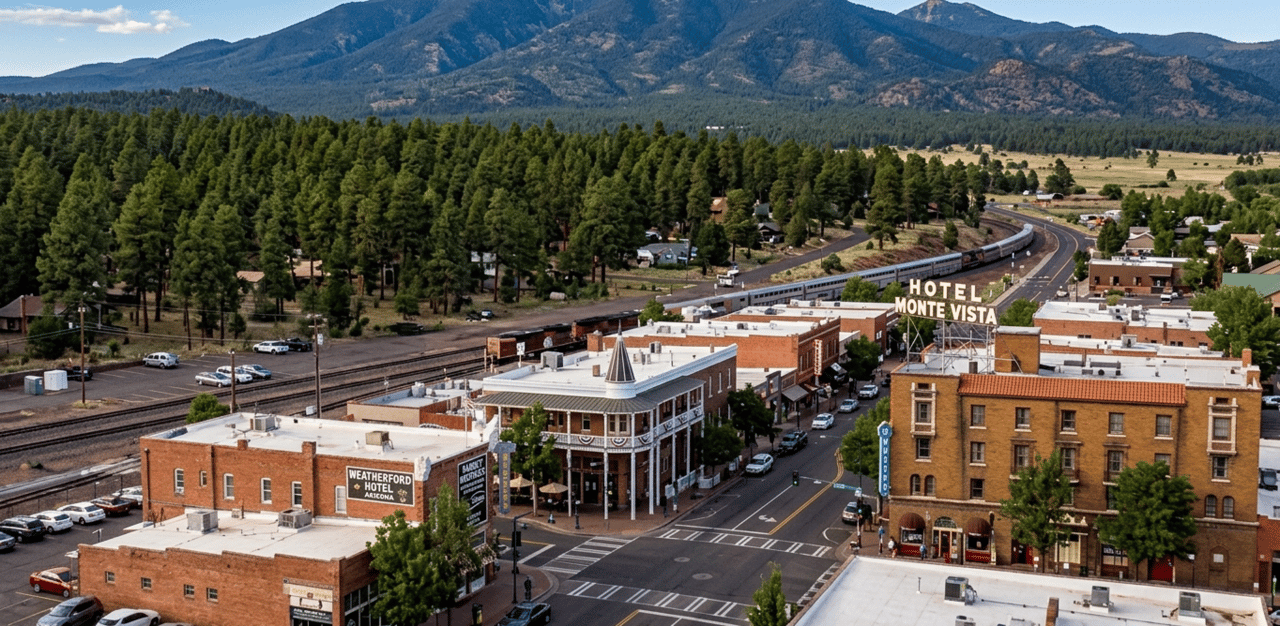
Sedona has the red rocks. Prescott has the small-town charm. But Flagstaff offers something neither can: elevation. Sitting at roughly 7,000 feet, Flagstaff runs 25–30 degrees cooler than Phoenix through the summer months, with actual seasons — aspen color in October, snowfall around the San Francisco Peaks in winter, and alpine summers that never touch triple digits.
For a Scottsdale or Paradise Valley homeowner, that's not just comfort. It's a two-hour drive from a primary residence to a genuinely different climate, without the flight time, currency conversion, or property management headaches of an out-of-state or international second home.
The Flagstaff Real Estate Market Right Now
Flagstaff's market behaves differently than the Phoenix metro. Inventory is naturally constrained — surrounded by the Coconino National Forest, hemmed in by federal and tribal land, and subject to stricter development limits than sprawling Valley suburbs. That geography is the single biggest driver of long-term value here.
Factor | Flagstaff | Phoenix/Scottsdale |
|---|---|---|
Elevation | ~7,000 ft | ~1,100 ft |
Summer highs | Upper 70s–low 80s | 105–115+ |
Land availability | Constrained by forest/federal land | Comparatively abundant |
Buyer profile | Second-home, university, remote work | Primary residence, relocation, snowbird |
Inventory turnover | Slower, more competitive | Faster, higher volume |
Because supply can't expand the way it does in the Valley, well-located Flagstaff properties — particularly those near downtown, the Peaks, or Northern Arizona University — tend to hold value and appreciate steadily even through broader market corrections.
What Kind of Buyer Is Purchasing in Flagstaff?
The buyer pool breaks down into a few consistent categories:
- Heat-refugee second-home buyers — Valley homeowners purchasing a summer retreat or four-season getaway.
- NAU-adjacent investors — buyers acquiring property near Northern Arizona University for rental income or a future family use case.
- Remote-work relocators — buyers who tested Flagstaff as a second home and are now considering it as a primary residence.
- Recreation-driven buyers — clients purchasing specifically for proximity to skiing at Arizona Snowbowl, hiking, and the surrounding national forest.
Is Flagstaff a Good Investment for a Second Home?
For most of my clients, the honest answer is yes — with the caveat that "investment" here means both lifestyle return and financial return. Limited land, a captive university population, a growing remote-work base, and consistent tourism demand all support long-term value. It is not a speculative flip market; it's a hold-and-enjoy market that has historically rewarded patient owners.
What Should Buyers Know Before Purchasing in Flagstaff?
A few things surprise Valley buyers moving into the high country for the first time:
- HOA and lot restrictions vary widely by neighborhood — some communities near the Peaks have specific architectural and defensible-space requirements tied to wildfire mitigation.
- Winterization matters. Homes require different systems — heating, roofing, insulation — than a Valley property, and that affects both purchase price and ongoing carrying costs.
- Short-term rental rules differ by jurisdiction. If income potential is part of the decision, this needs to be confirmed property-by-property before you write an offer.
- Snow load and access can affect winter usability of a property, particularly further out toward Mountainaire, Kachina Village, or the Peaks itself.
This is where local, on-the-ground guidance matters more than an automated valuation tool ever could — a Zillow estimate won't tell you which side of a ridge holds snow into April, or which HOA has stricter short-term rental enforcement.
Flagstaff vs. Other Arizona Second-Home Markets
Clients often ask how Flagstaff compares to Sedona, Prescott, or Payson as an escape-the-heat option. The short version: Sedona commands a premium for scenery and proximity but runs warmer than Flagstaff in summer; Prescott offers a milder middle ground with more inventory but less elevation relief; Payson is closer to Phoenix but has a smaller luxury segment. Flagstaff remains the clearest trade of drive-time for genuine climate change — which is exactly why it continues to draw serious second-home buyers rather than casual lookers.
The Bottom Line
Flagstaff isn't just an escape from the heat — it's a market with its own fundamentals: constrained supply, a durable buyer base, and a lifestyle draw that keeps demand steady across seasons. For Phoenix and Scottsdale homeowners weighing a second property, it remains one of the few Arizona markets where comfort and long-term value point in the same direction.
If you're exploring a second home in Flagstaff or want a market comparison against Sedona, Prescott, or your current Scottsdale property, I'm happy to walk through current inventory and pricing trends.