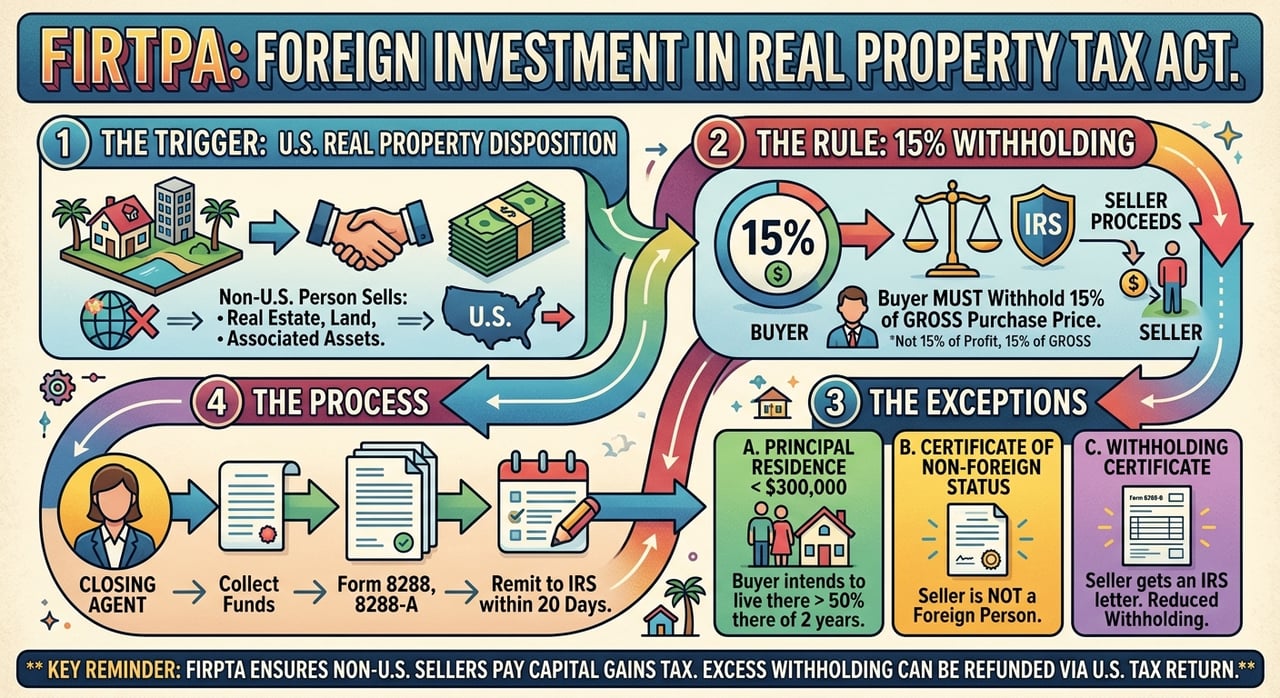
When selling real estate in the United States as a foreign investor, understanding your tax obligations is critical. The Foreign Investment in Real Property Tax Act (FIRPTA) governs how tax withholding is handled during property sales involving non-U.S. residents.
1. Summary Answer
FIRPTA is a federal tax law requiring buyers to withhold up to 15% of the total purchase price—not just the profits—when acquiring U.S. real estate from a foreign seller. This money is remitted directly to the IRS as a deposit toward the seller's actual U.S. capital gains tax liability.
2. Semantic Questions
Does FIRPTA apply if I sell my property at a loss? Yes. Withholding is based on the gross sales price, not net profit. However, you can file a U.S. tax return (Form 1040-NR) to claim a full refund if no tax is owed.
Who is responsible for collecting and remitting FIRPTA tax? The buyer (transferee) is legally responsible as the withholding agent. If the buyer fails to withhold, they can be held personally liable for the tax, penalties, and interest.
How can a foreign seller reduce or eliminate FIRPTA withholding? Sellers can submit IRS Form 8288-Bbefore closing to request a Withholding Certificate, reducing the amount to match estimated actual capital gains tax.
3. FIRPTA Withholding Breakdown & Steps
Key Steps in a FIRPTA Transaction
Determine Seller Status: Confirm if the seller meets the definition of a foreign person.
Apply for ITIN (if needed): Ensure all foreign individuals have a U.S. Individual Taxpayer Identification Number.
Submit Form 8288-B (Optional): Apply for a reduced rate prior to closing if expected taxes are lower than 15%.
Remit Withholding: The buyer/closing agent submits Forms 8288 and 8288-A with the funds to the IRS within 20 days of closing.
File Tax Return: The seller files a Form 1040-NR to calculate final taxes and request any overpayment refund.
4. Internal Linking
Learn more about our Cross-Border Tax Advisory Services to navigate international property sales seamlessly.
Read our complete breakdown on Filing Form 1040-NR for Foreign Investors.
Discover strategies for IRS Form 8288-B Withholding Certificate Applications to protect your transaction cash flow.
5. Local Context
FIRPTA applies to real estate transactions in all 50 states. However, state-level withholding requirements vary significantly. For instance, selling property in states like California or Hawaii triggers additional state-level foreign seller withholdings alongside federal FIRPTA regulations. Always verify regional escrow and title compliance rules with a local real estate attorney or CPA before closing.
6. Entity Authority
Internal Revenue Service (IRS): Codified under Internal Revenue Code Section 1445.
Governing Forms: IRS Form 8288, Form 8288-A, Form 8288-B, and Form 1040-NR.
Primary Entities Covered: Foreign Individuals, Foreign Corporations, Foreign Partnerships, and Foreign Trusts/Estates.